
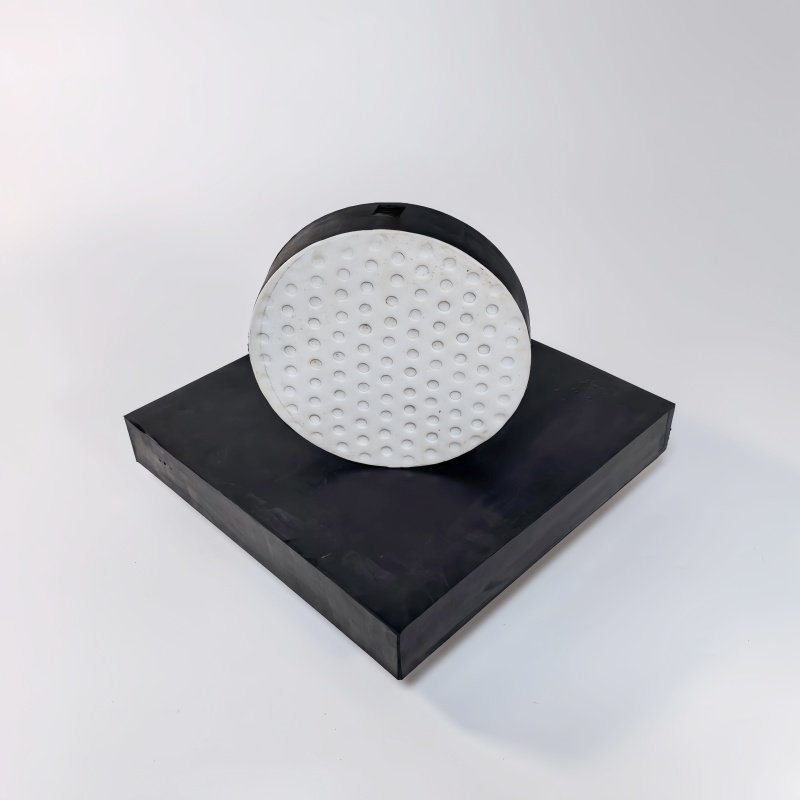
Elastomeric Bridge Bearing – Laminated Rubber & Steel Plate
Our elastomeric bridge bearing (also known as laminated rubber bearing or steel‑reinforced elastomeric pad) is a high‑performance structural support device manufactured by vulcanizing multiple layers of premium rubber with internal steel plates. This design provides high vertical stiffness to support heavy bridge loads while allowing the shear deformation needed to accommodate beam‑end rotations and horizontal movements. Available in rectangular (GJZ) and circular (GYZ) shapes, with standard or PTFE sliding options.
What is an Elastomeric Bridge Bearing?
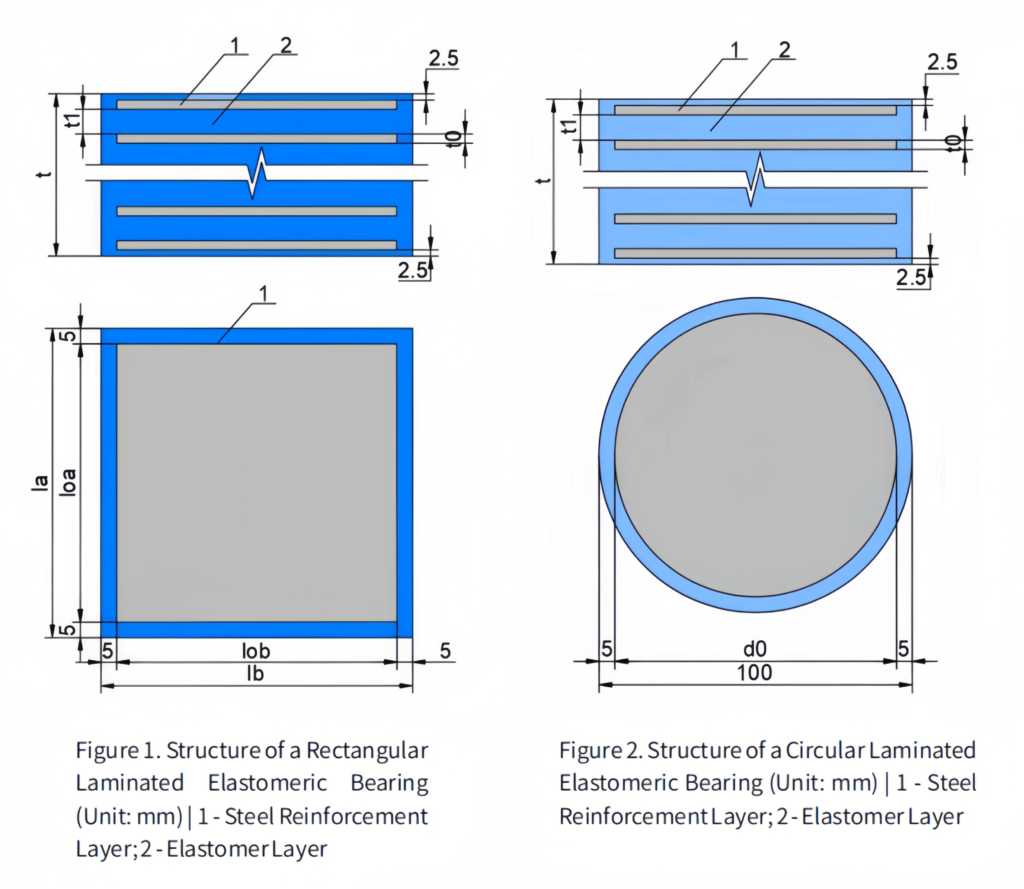
An elastomeric bridge bearing consists of alternating layers of elastomer (natural rubber or neoprene) and mild steel plates, bonded together under heat and pressure. The steel plates restrict lateral bulging under load, giving the bearing high vertical load capacity. The rubber layers provide flexibility to absorb rotations and shear displacements caused by temperature changes, traffic loads, and seismic events. This type of bearing is widely used in highway bridges, railway bridges, and viaducts due to its simple structure, low cost, and maintenance‑free performance.
Key Features
- Steel‑reinforced laminated construction – Multiple internal steel plates ensure uniform load distribution and prevent rubber extrusion.
- High vertical load capacity – Standard models support loads from 100 kN up to 740 kN (custom higher loads available).
- Shear deformation capacity – Accommodates horizontal movement up to 30 mm (or more with PTFE sliding type).
- Rotation capability – Allows beam‑end rotation up to 0.01‑0.02 rad.
- Material options – Choose Neoprene (CR) for normal temperature zones (-25°C to +60°C) or Natural Rubber (NR) for cold regions (-40°C to +60°C).
- Low maintenance – No moving parts; fully encapsulated steel plates prevent corrosion.
- Easy installation – Direct placement on padstones or embedded steel plates.
- Compliance – Meets AASHTO M 251, EN 1337‑3, GB/T 17955 standards.

Figure: Elastomeric bridge bearing – steel-reinforced laminated pad
Types & Designation
Our elastomeric bearings are classified by structural type and temperature range:
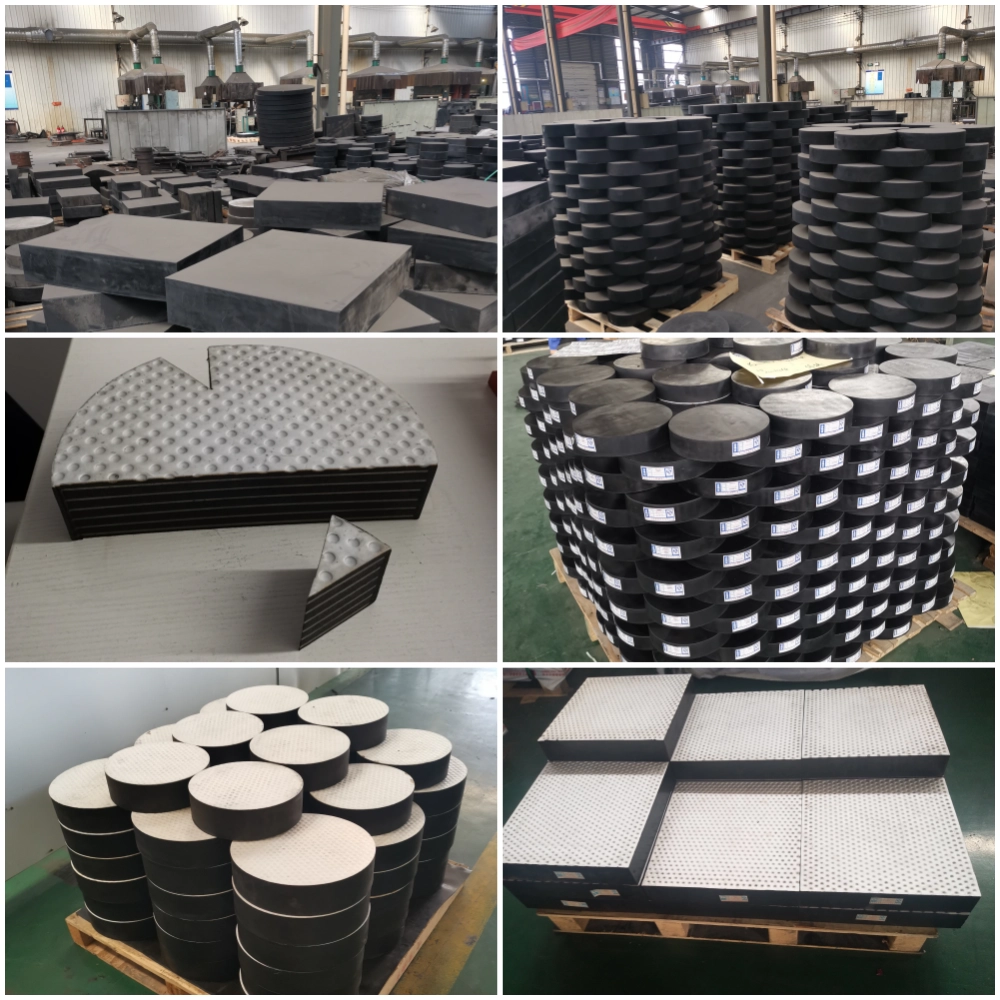
- GJZ Series – Rectangular laminated elastomeric bearing (standard).
- GYZ Series – Circular laminated elastomeric bearing (ideal for curved or skewed bridges).
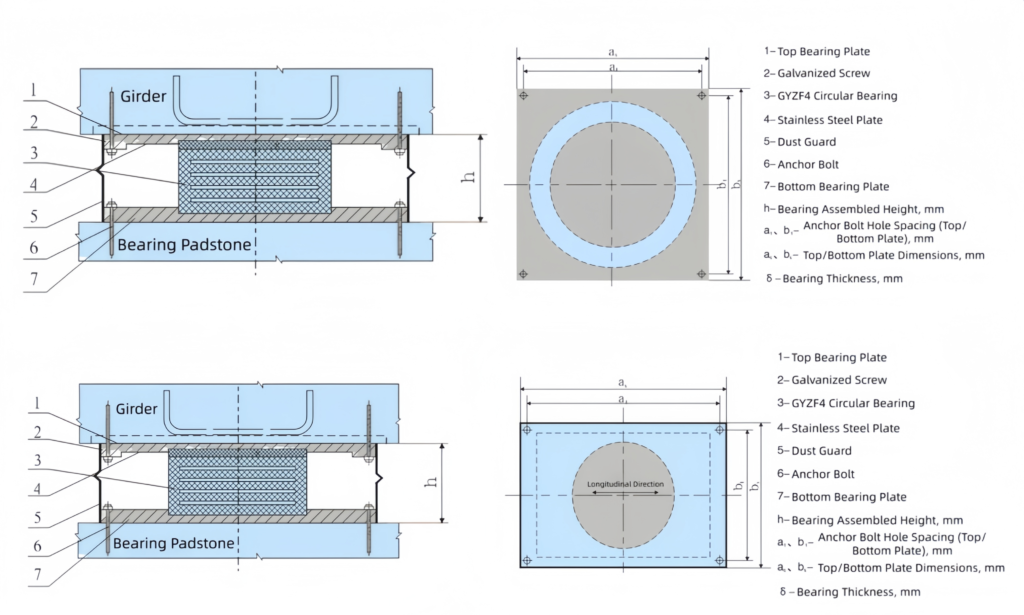
- GJZF4 / GYZF4 Series – PTFE sliding elastomeric bearing, with a bonded PTFE plate and stainless steel counterplate for large horizontal displacement (up to ±30mm or more).
- Temperature types: “A” = Neoprene (CR) for moderate temperature (-25°C to +60°C); “B” = Natural rubber (NR) for cold resistance (-40°C to +60°C).
Applications
Our elastomeric bearings are widely used in:
- Highway and railway bridges (precast or cast‑in‑place).
- Pedestrian bridges, flyovers, and viaducts.
- Curved, skewed, and wide bridges (use circular bearings).
- Seismic retrofit projects (with PTFE sliding or isolator bearings).
- Building structures requiring vibration isolation.
Installation Guide (Overview)
- Prepare padstone – Ensure pier/abutment top is clean, level, and ≥6cm higher than bearing height for future jacking. Cast reinforcement mesh in padstone (concrete grade ≥C25).
- Mark centerlines – Draw cross‑shaped centerlines on both the padstone and the bearing.
- Position bearing – Place bearing on padstone, aligning marks. For girder with longitudinal slope >1%, use a steel wedge or cast slope on padstone.
- For cast‑in‑place girder – Place a support steel plate on top of bearing, weld anchor bars to girder reinforcement, and cast girder. Ensure no grout leakage.
- For precast girder – Lower girder slowly after confirming bearing position. Use epoxy mortar to bond upper steel plate if needed.
- Check after installation – Verify no eccentric compression, no initial shear deformation, and all bearings are coplanar.
- For PTFE bearings – Fill lubricant dimples with 5201 silicone grease. Ensure stainless steel plate is smooth and correctly offset according to installation temperature.
Frequently Asked Questions (FAQ)
Q: What is the difference between GJZ and GYZ bearings?
A: GJZ is rectangular, GYZ is circular. Circular bearings are recommended for curved, skewed, or wide bridges because they are isotropic (same performance in all directions).
Q: What rubber material should I choose?
A: Use Neoprene (CR) for normal temperature areas (-25°C to +60°C). Use Natural Rubber (NR) for cold regions (-40°C to +60°C). NR has better low‑temperature elasticity.
Q: How much horizontal movement can a standard bearing accommodate?
A: Standard laminated bearings can accommodate up to 30mm shear displacement (depending on rubber thickness). For larger displacement, use PTFE sliding bearings.
Q: How to adjust if the bearing is not fully contacted after installation?
A: Jack up the girder end, apply a layer of cement mortar or epoxy mortar on the top/bottom of the bearing, then lower the girder. The bearing will self‑level under load.
Q: Do you provide custom sizes?
A: Yes, we manufacture any dimension, load capacity, and shape (rectangular, circular, or special). Please send your design drawings and requirements.
Why Choose Guchen Elastomeric Bridge Bearings?
As a professional bridge bearing manufacturer with over 15 years of experience, we offer:
- Premium rubber compounds (NR/CR/EPDM) and Q235B steel plates.
- Fully bonded vulcanization – no delamination.
- Strict quality control – each bearing tested for shear, compression, and adhesion.
- Compliance with AASHTO, EN, GB, and other international standards.
- Custom designs – GJZ, GYZ, GJZF4, GYZF4 series from stock or made to order.
- Factory direct pricing + fast global shipping.
- Technical support, installation drawings, and after‑sales service.
📞 Get a quote for elastomeric bridge bearings – Send your required dimensions, load, movement, and climate condition. We will reply within 24 hours.