
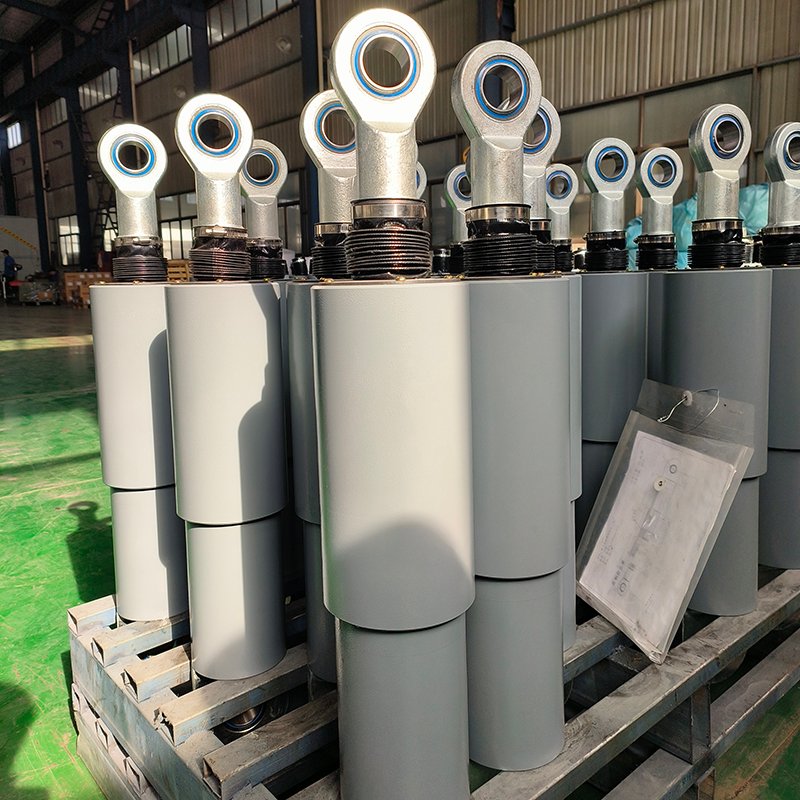
Fluid Viscous Damper (VFD Series) – Architectural Seismic & Wind Energy Dissipation Device
Our fluid viscous damper (VFD series), also known as architectural viscous damper or seismic damper, is a passive, velocity‑dependent energy dissipation device designed for buildings, bridges, and other structures. It effectively absorbs and dissipates vibration energy caused by earthquakes, wind loads, moving loads, and machinery oscillations, thereby protecting the primary structure from damage. With a compact, symmetrical design and high energy efficiency (up to 90%), it is easy to install, maintain, and replace.
What is a Fluid Viscous Damper?
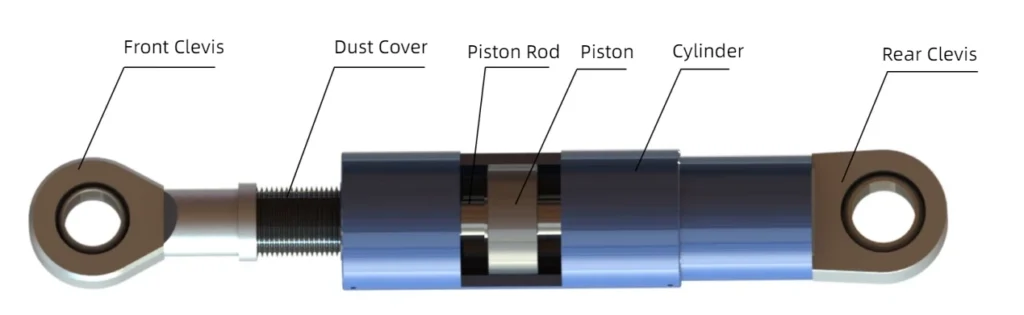
A fluid viscous damper consists of a front clevis, dust cover, piston rod, cylinder filled with high‑viscosity silicone‑based fluid, and a rear clevis. When the piston moves relative to the cylinder, the fluid is forced through orifices, generating a damping force that opposes motion. The damper absorbs and dissipates kinetic energy, converting it into heat. It is a purely mechanical device with no springs or friction parts, ensuring long‑term reliability and minimal maintenance.
The relationship between damping force, damping coefficient, velocity exponent, and piston velocity is given by:
F = C V^α
Where:
- F = Damping force (kN)
- C = Damping coefficient (constant during operation, kN/(mm/s)α)
- V = Piston velocity relative to cylinder (mm/s)α
- α = Velocity exponent (dimensionless, adjustable between 0.1 and 1.0)
Key Features
- High energy dissipation efficiency – Up to 90%, effectively reducing structural response.
- Clear position indication – Easy to read displacement scale shows piston location inside cylinder.
- Low resistance at low speed – Less than 10% of rated load, ensuring no interference with daily movements.
- Built‑in installation tolerance – ±25 mm length adjustment simplifies on‑site fitting.
- Pivot mount with spherical bearings – Allows ±6° swing angle, accommodating angular misalignments and structural movements.
- Stable hydraulic fluid – Anti‑flammable, aging‑resistant, and compatible with all seals.
- Excellent sealing – High‑quality seals ensure no leakage over the service life.
- Easy installation & maintenance – Can be installed as wall‑mounted damper or steel‑brace configuration.
Technical Specifications – Standard VFD Models
The table below lists the commonly used VFD series viscous dampers. All models support a stroke range of 0 to ±500 mm and a velocity exponent α from 0.1 to 1.0. Custom strokes, loads, and dimensions are available upon request.
| Model | Rated Load (kN) | Stroke (mm) | Velocity Exponent α | Outer Diameter D (mm) | Pin Hole Diameter d (mm) |
|---|---|---|---|---|---|
| VFD‑100 | 100 | 0‑±500 | 0.1‑1.0 | 125 | 40 |
| VFD‑200 | 200 | 0‑±500 | 0.1‑1.0 | 150 | 50 |
| VFD‑300 | 300 | 0‑±500 | 0.1‑1.0 | 150 | 50 |
| VFD‑400 | 400 | 0‑±500 | 0.1‑1.0 | 194 | 60 |
| VFD‑500 | 500 | 0‑±500 | 0.1‑1.0 | 145 | 80 |
| VFD‑600 | 600 | 0‑±500 | 0.1‑1.0 | 194 | 80 |
| VFD‑700 | 700 | 0‑±500 | 0.1‑1.0 | 245 | 90 |
| VFD‑800 | 800 | 0‑±500 | 0.1‑1.0 | 273 | 90 |
| VFD‑900 | 900 | 0‑±500 | 0.1‑1.0 | 273 | 100 |
| VFD‑1000 | 1000 | 0‑±500 | 0.1‑1.0 | 273 | 100 |
| VFD‑1100 | 1100 | 0‑±500 | 0.1‑1.0 | 273 | 110 |
| VFD‑1200 | 1200 | 0‑±500 | 0.1‑1.0 | 273 | 110 |
Note: Custom strokes (e.g., ±100mm, ±200mm) and loads beyond the standard range are available. The model naming convention includes the required stroke (e.g., VFD‑100‑±50 denotes 100kN with ±50mm stroke). Please specify your requirements.
Applications
Our VFD viscous dampers are widely used for seismic and wind vibration control in:
- High‑rise buildings – Reduce wind‑induced sway and earthquake response.
- Long‑span structures – Stadiums, convention centers, airport terminals.
- Bridges – Isolate deck movement and dissipate seismic energy.
- Industrial equipment foundations – Absorb vibration from rotating machinery.
- Seismic retrofitting – Upgrade existing buildings to meet modern codes.
- Pipelines and cable towers – Dampen vibration caused by flow or wind.

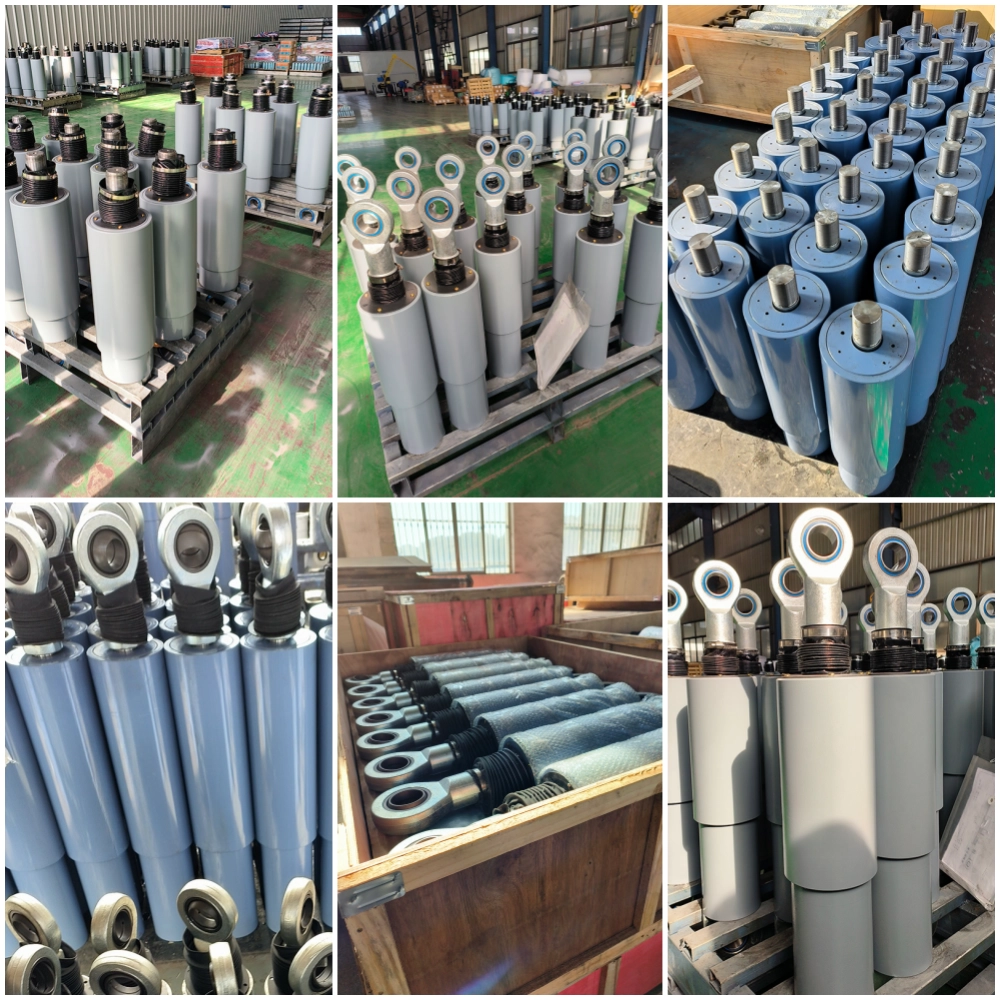
Figure: Manufacturing of VFD fluid viscous damper – cylinder machining and assembly
Installation Configurations
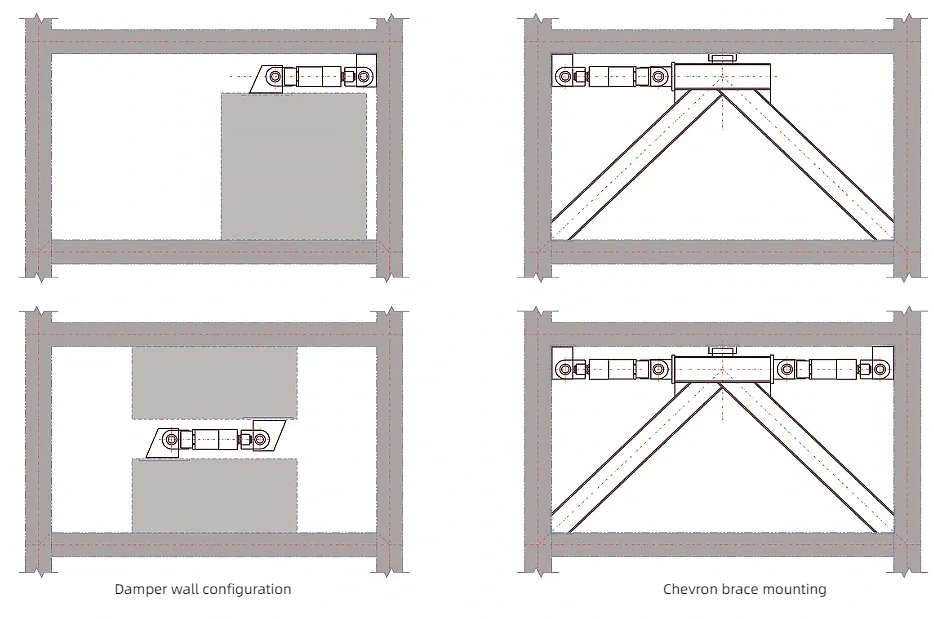
Our viscous dampers can be installed in two common arrangements:
- Wall‑mounted (damper wall) – Installed diagonally between floors or between walls and frames.
- Steel‑brace supported – Mounted inside chevron braces or single diagonals.
Thanks to the ±25 mm length adjustment and ±6° swing bearings, field installation is quick and forgiving.
Frequently Asked Questions (FAQ)
Q: What is the velocity exponent α and how does it affect performance?
A: α determines how damping force changes with piston speed. α = 1 gives linear (viscous) behavior; α < 1 provides increasing damping at higher velocities – ideal for seismic protection. We offer α from 0.1 to 1.0, customizable to your structural analysis.
Q: What is the maximum stroke available?
A: Standard stroke range is ±500 mm. Larger strokes are available upon request. The stroke must be matched to the expected structural displacement at the damper location.
Q: How do you ensure no leakage over time?
A: We use high‑grade seals selected for compatibility with the silicone‑based fluid, plus precision machining of cylinder and piston rod. Each damper is pressure‑tested before shipment.
Q: Can the damper be replaced or maintained easily?
A: Yes. The damper is bolted at both ends using clevis pins. After loosening the pins, the unit can be removed and replaced without affecting the structure.
Q: Do you provide design or calculation support?
A: Absolutely. We work with your structural engineer to determine the required damping coefficient C, velocity exponent α, load capacity, and stroke based on the building’s dynamic characteristics.
Why Choose Guchen Fluid Viscous Dampers?
As a professional viscous damper manufacturer with deep experience in seismic protection, we offer:
- High‑performance fluid viscous technology – proven efficiency up to 90%.
- Fully customizable parameters (load, stroke, α, clevis type).
- Robust construction with ±25 mm length adjustment and ±6° swing.
- Stringent quality control – each damper tested for force, stroke, and leakage.
- Compliance with international codes (ASCE, Eurocode 8, GB/T 2006).
- Factory direct pricing and global shipping.
- Engineering support and detailed installation manuals.
📞 Get a quote for VFD viscous dampers – Send your required load (kN), stroke (mm), velocity exponent, and connection details. We will reply within 24 hours.