
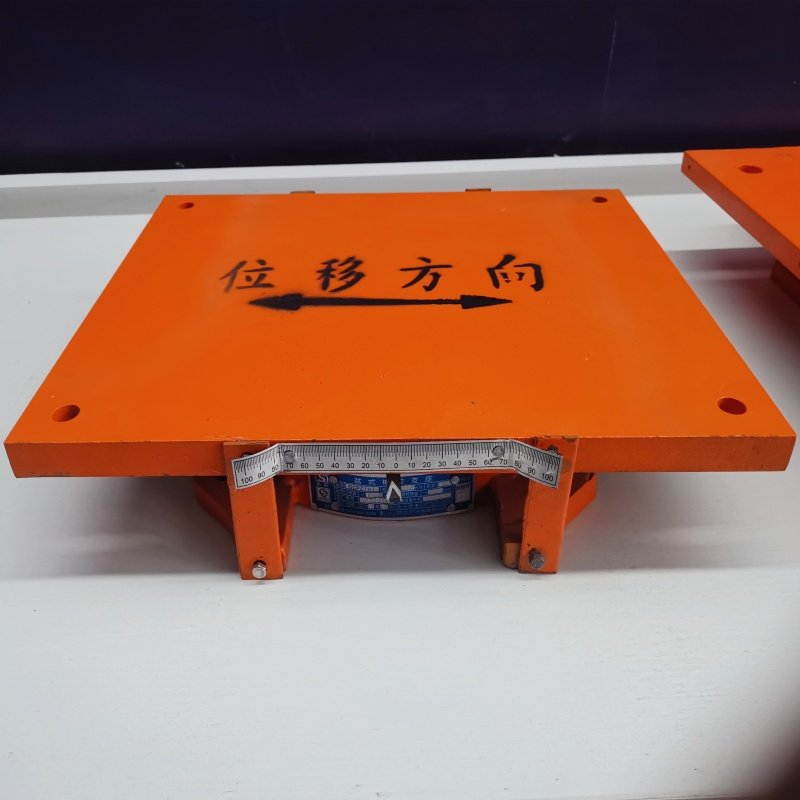
Pot Type Rubber Bearing – Reliable Bridge Bearing for Heavy Load & Large Displacement
Our Pot Type Rubber Bearing (also known as pot bearing) is a high-performance bridge bearing designed to withstand extreme vertical loads, horizontal forces, and multi-directional movements. It combines the flexibility of elastomeric rubber with the strength of a steel pot, making it the ideal choice for large-span bridges, viaducts, and highway structures.
What is a Pot Bearing?
A pot bearing consists of a steel pot, an elastomeric rubber pad, a sealing ring, a stainless steel plate, and a PTFE sliding surface. The rubber pad is confined within the steel pot, providing excellent rotational capacity while supporting heavy vertical loads. When combined with a PTFE sliding element, the bearing can accommodate large longitudinal and transverse displacements. This structure ensures durability, low maintenance, and reliable performance under extreme conditions.
Pot rubber bearings are classified into three types: fixed bearings (GD), unidirectional movable bearings (DX), and bidirectional movable bearings (SX). Each type has its own characteristics.
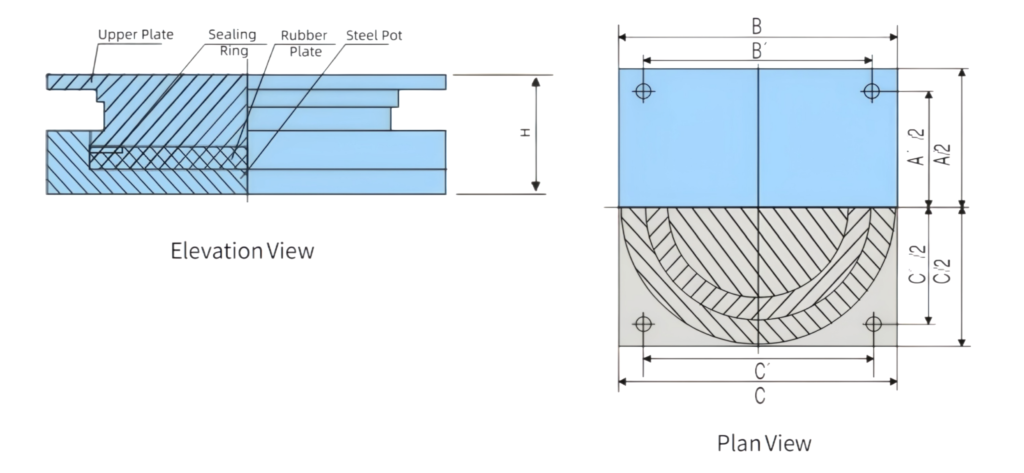
Fixed pot bearings (GD) restrict horizontal displacement of the girder in any direction, while allowing vertical movement at the bearing location.

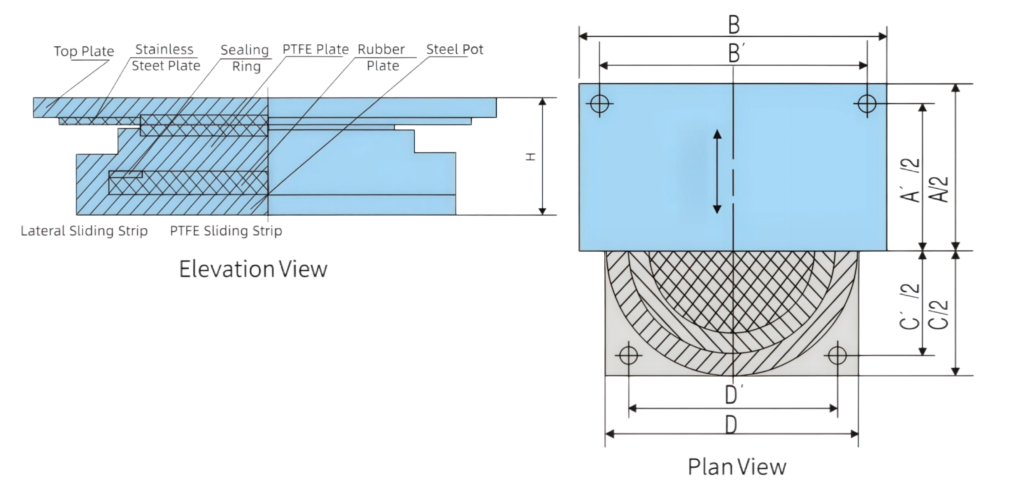
Figure: Cross section of fixed pot bearing (GD type) – rotation permitted, horizontal displacement restricted Bidirectional movable pot bearings (SX) can accommodate horizontal displacement in any direction.

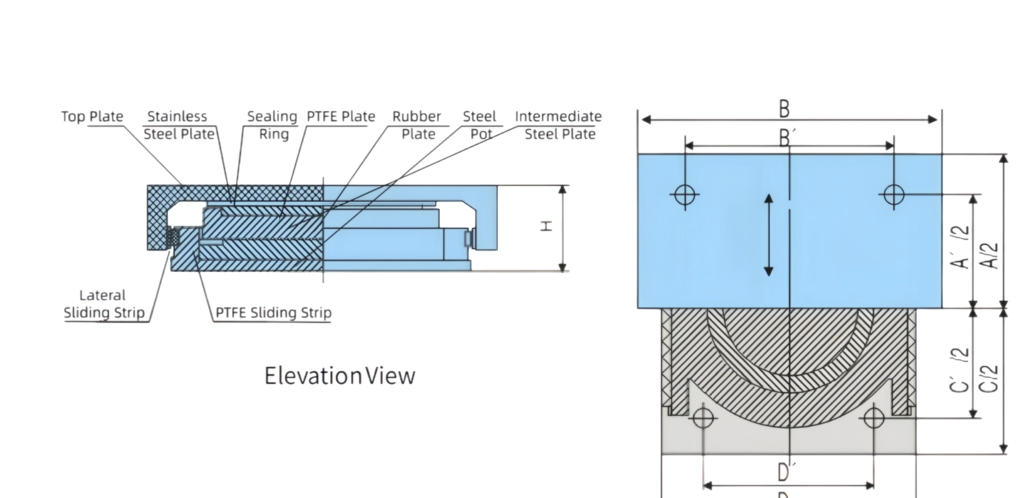
Figure: Structural diagram of bidirectional movable pot bearing (SX type) Unidirectional movable pot bearings (DX) can only accommodate horizontal displacement parallel to the two guide blocks; horizontal displacement in other directions is restricted by the guide blocks.

Figure: Structural diagram of unidirectional movable pot bearing (DX type) – guided displacement parallel to guide blocks
Key Features of Our Pot Type Rubber Bearing
- High Load Capacity – Supports vertical loads from hundreds to thousands of tons, suitable for heavy-duty bridges.
- Large Rotation Angle – The confined rubber pad allows smooth rotation up to 0.02 rad or more.
- Low Friction Sliding – PTFE + stainless steel sliding surface offers a friction coefficient as low as 0.03, enabling free displacement.
- Seismic Resistance – Optional seismic pot bearing designs for earthquake-prone zones.
Types of Pot Bearings We Supply
We offer a complete range of pot bearings to meet different bridge design requirements:
- Fixed Pot Bearing – Allows rotation only, no displacement. Ideal for load anchoring points.
- Sliding Pot Bearing – Allows both rotation and multi-directional sliding (using PTFE).
- Guided (Unidirectional) Pot Bearing – Allows rotation and movement in one direction, restricts lateral movement.
- Pot PTFE Bearing – Specifically designed with PTFE sliding layer for low-friction displacement.
Technical Specifications (Typical)
| Parameter | Value |
|---|---|
| Vertical load capacity | 1000 kN – 80,000+ kN |
| Rotation angle | 0.01 – 0.02 rad (customizable) |
| Horizontal displacement (sliding type) | ±20 mm to ±300 mm |
| Friction coefficient (PTFE/steel) | ≤0.03 (lubricated) / ≤0.05 (dry) |
| Operating temperature | -40°C to +60°C |
Applications
Our pot type rubber bearings are widely used in:
- Long-span highway and railway bridges
- Urban viaducts and flyovers
- Pedestrian bridges and overpasses
- Seismic-resistant bridge structures
- Steel and concrete girder bridges

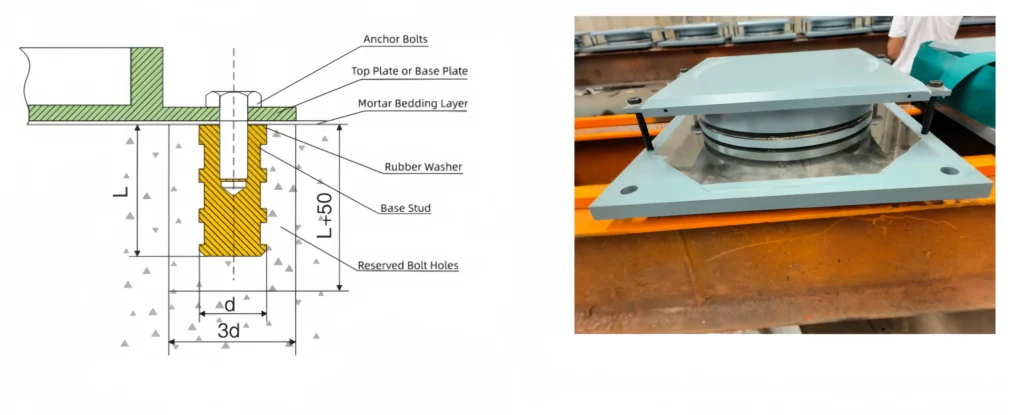
Figure: Bolt installation diagram for pot bearing – components and positioning
Why Choose Our Pot Bearings?
As a professional pot bearing manufacturer and supplier, we provide factory-direct prices, strict quality control (ISO 9001 certified), and customized solutions. Every bearing is tested for load capacity, rotation, and sliding performance before delivery. We also offer free technical support, installation guidance, and fast worldwide shipping.
👉 Get a pot bearing quote – Send us your project requirements (load, displacement, rotation angle) and we will reply within 24 hours.